Attention all students targeting Italian university bachelor’s programmes for the 2026/2027 academic year and beyond: a major change to the required entrance exams is upcoming. The English TOLC exams (TOLC-I, E, and F) will be discontinued after November 2025, replaced by a single new test: the CEnT-S. This shift brings significant changes to the exam’s structure, timing, and potentially its content. In this post, we’ll break down everything you need to know to prepare for the CEnT-S successfully.
Why the Change? The Rationale Behind the CEnT-S
Various friction points in the TOLC exam system have led to consolidating the English TOLC-I, E, and F into a single, unified exam. Hopefully, this change makes the admission process more efficient and streamlined for both students and university program administrators.
Although Cisia has not officially specified the reasons for this change, here are some potential benefits of the upcoming update:
- Benefits of the new update:
- Efficiency for Students: Allowing students to take one exam for multiple course options, similar to the SAT/ACT.
- Modernization: Updating the exam structure to better reflect contemporary academic skills.
- Fair and Accurate: Limited exam dates and normalized scores (explained later in the post) will lead to tighter security and fewer chances of cheating. These updates will make sure every candidate receives a score that accurately reflects their performance.
Side-by-Side Comparison: TOLC vs. CEnT-S
| Feature | Old System (TOLC-I, E and F) | New System (CEnT-S) |
|---|---|---|
| Number of Exams | Three separate, specialized exams. | Single Exam |
| Intended Programmes | TOLC-I (Engineering), TOLC-E (Economics), TOLC-F (Science) | A broader range of STEM, Economics, and related fields. |
| Core Structure | Different sections for each TOLC. | A common core + specific subject sections. |
| Sections & Subjects | Specific subjects for each TOLC. Ex: TOLC-E (Maths, Logic and English) | Mathematics Reasoning on texts and data Physics Chemistry Biology |
| Number of Questions | TOLC-E -36 questions TOLC-I-50 questions TOLC-F – 50 questions | Total of 55 questions |
| Duration (Timing) | TOLC-E = 90 minutes TOLC-I – 110 minutes TOLC-F = 72 minutes | 110 minutes total |
| Scoring System | 1 point for each correct answer 0 points for each unanswered question a penalty of 0.25 points for each incorrect answer. | Same pointing system as the old system but the final score is normalized. (more on it later…) |
| Cost | 35.00 Euro | 55.00 Euro |
Breakdown: The Structure of the CEnT-S Exam
- Total of 55 questions – 110 minutes
- Mathematics – 15 questions
- Logical reasoning on text and data – 15 questions
- Physics – 5 questions
- Chemistry – 10 questions
- Biology – 10 questions
Testing Modes
Like all of CISIA’s entry tests, the CEnT-S will be available in 2 formats:
- @UNI – in person on the campuses of host universities
- @HOME – online remotely
When you can take the CEnT-S
This is one of the more crucial changes from the old system. Previously, you were able to take the TOLC exam as many times as you wanted. With the new system, there will be 4 periods in which you can take the test, and applicants are allowed to register to take the test once in each period.
Each period will have 3 days in which the exam can be taken.
Here are the test dates according to period:
- First period test dates:
| First Period Days in which the exam can be taken |
|---|
| 27 November 2025 |
| 16 December 2025 |
| 15 January 2026 |
- Second period test dates:
| First Period Days in which the exam can be taken |
|---|
| 19 February 2026 |
| 26 February 2026 |
| 12 March 2026 |
- Third period test dates:
| First Period Days in which the exam can be taken |
|---|
| 23 April 2026 |
| 21 May 2026 |
| 9 June 2026 |
- Fourth period test dates:
| First Period Days in which the exam can be taken |
|---|
| 17 September 2026 |
| 15 October 2026 |
- – NB: if you are a non-EU applicant requiring a visa, then it’s recommended that you take the exam in the 1st or 2nd period to avoid late rejections. Remember to align their exam date with the application deadlines for your target universities. Following is the official page for Ca’ Foscari
Who Needs to Take the CEnT-S?
All universities that require TOLC for entry to their bachelor’s program will switch to CEnT-S starting in November 2025. So if you are an applicant who is hoping to apply for a bachelor’s program in the 2026/2027 academic year and beyond, you will need to take the CEnT-S exam.
Some universities will offer alternate entry requirements, such as the SAT, for which I highly recommend that you visit the official university website program page to find out more.
Final Test Results and Normalization of Scores
With the old system of TOLC exams, you got your final score within 24 hours of completing the exam. But now they are released on specific dates after normalization of scores.
The Test Results Release dates are:
- First period: 30 January 2026
- Second period: 31 March 2026
- Third period: 30 June 2026
- Fourth period: 30 October 2026
The release of results only after each testing period is concluded is due to a statistical process known as normalization. This crucial step ensures fairness for all candidates.
Under the previous system, exams were generated from a large question bank. This meant that some candidates, by chance, received a version of the test they perceived as easier, while others received a more challenging set of questions. A key limitation was that the system did not account for these variations in difficulty; everyone’s score was calculated the same way, regardless of the test version they received.
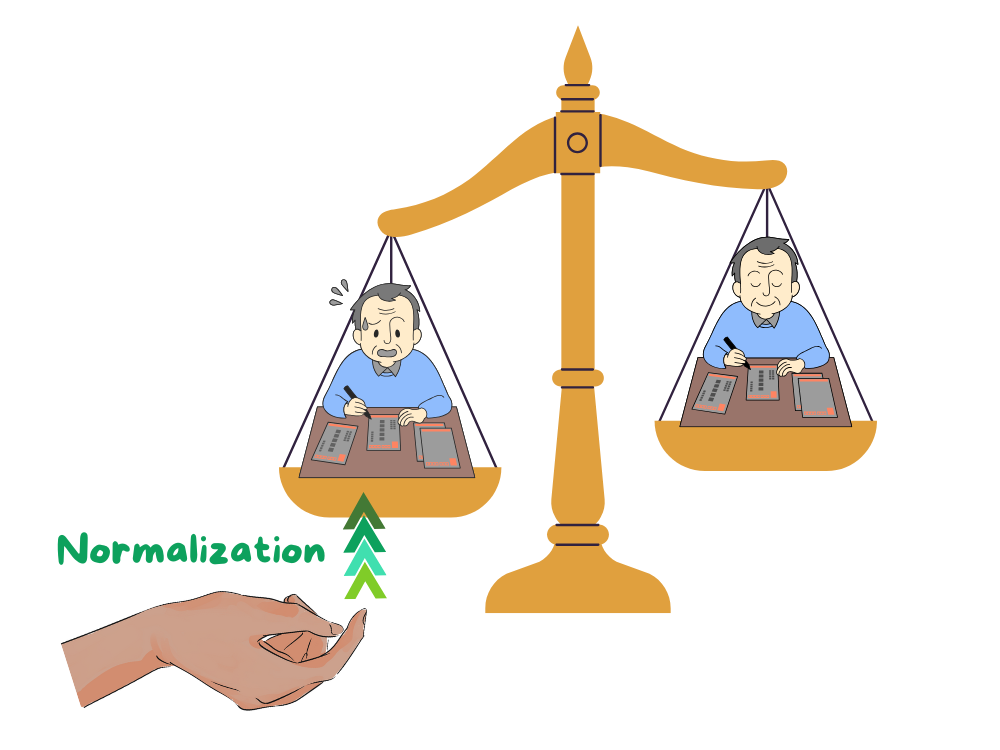
The new system will also generate exams from a question bank, but will account for the difficulty of the tests through a process called normalization. For ease of understanding, imagine the following scenario:
Let’s say 100 candidates take an easier version of the CenT-S on November 27th, while another 100 face a tougher version on December 16th. Without adjustment, the first group would have an unfair advantage.
Normalization fixes this. Think of it like a fair judge who sees that one race was run with a strong tailwind and another into a headwind. The judge adjusts the times to account for the conditions. Similarly, normalization evaluates the difficulty of each exam session and adjusts scores accordingly. This ensures that a score from a difficult test is equivalent to the same score from an easier one, creating a level playing field for all.
PS: At the time of writing this article, there isn’t a dedicated section for registration for the CenT-S exam on CISIA, but I encourage you to check CISIA’s website regularly.

Leave a Reply